

Motomasa Suzuki


Exhibition at TSCA
- Motomasa Suzuki|Scenery reflected in the window 14 December - 1 February, 2025
- TSCA Collection | Foresights and Flow 26 January - 23 February, 2019
- Motomasa Suzuki | wall, roof, window 11 June - 9 July, 2016
- Ryuta Iida, Motomasa Suzuki, Mai Yamashita + Naoto Kobayashi, Yoshitaka Yazu | Group Exhibition 26 March - 23 April, 2016
- Motomasa Suzuki | Eyes/ The form/ An image 6 July - 11 August, 2012
- Takahiro Kamimura, Motomasa Suzuki | TSCA Rough Consensus 17 February - 20 March, 2012
- Takuro Ishii, Motomasa Suzuki, Mai Yamashita + Naoto Kobayashi | Gallery Collection 28 August - 25 September, 2010
- Motomasa Suzuki | World is Yours 27 February - 27 March, 2010
Profile |
|
||||||||||||||||||||||||||||||||||||||||
|---|---|---|---|---|---|---|---|---|---|---|---|---|---|---|---|---|---|---|---|---|---|---|---|---|---|---|---|---|---|---|---|---|---|---|---|---|---|---|---|---|---|
Awards |
|
||||||||||||||||||||||||||||||||||||||||
Solo Exhibitions |
|
||||||||||||||||||||||||||||||||||||||||
Group Exhibition |
|
||||||||||||||||||||||||||||||||||||||||
Publication |
|||||||||||||||||||||||||||||||||||||||||
Collection |
|||||||||||||||||||||||||||||||||||||||||
Others |
|
||||||||||||||||||||||||||||||||||||||||
Profile
| 2004 | Graduated BA, Musashino Art University, Department of Sculpture |
|---|---|
| 1981 | Born in Shizuoka, Japan |
Awards
| 2017 | Vision of Contemporary Art (VOCA) 2017 (Ueno Royal Museum, Tokyo) |
|---|---|
| 2010 | The 10th Gunma Biennale for Young Artists (The Museum of Modern Art, Gunma) |
| 2007 | The 11th Okamoto Taro Memorial Award |
| 2006 | Semi-Grand Prix Art Award from Jeans Factory |
| 2003 | "ARTISTS BY ARTISTS" |
Solo Exhibitions
| 2025 | a piece of cake , Dai-ichi Life Gallery, Tokyo, Japan |
|---|---|
| 2024 | Scenery reflected in the window , Takuro Someya Contemporary Art, Tokyo, Japan |
| 2021 | CADAN x ISETAN MEN'S : Seasonal Cohabit~Winter & Spring~, Isetan Men's Store Shinjuku 1F, Tokyo |
| 2019 | TSCA Collection | Foresights and Flow, Takuro Someya Contemporary Art, Tokyo |
| 2017 | Motomasa Suzuki exhibition MOD, LIXIL Gallery, Tokyo |
| 2016 | wall, roof, window, Takuro Someya Contemporary Art, Tokyo Honest Place, Plaza North, Saitama |
| 2013 | Cinematic Orchestra, LIXIL Gallery, Tokyo |
| 2012 | Eyes / The form / An image, Takuro Someya Contemporary Art, Tokyo |
| 2010 | World is Yours, Takuro Someya Contemporary Art, Tokyo |
| 2007 | Motomasa Suzuki, Muramatsu Gallery, Tokyo |
| 2005 | Motomasa Suzuki, Seika Gallery, Tokyo Motomasa Suzuki, Gallery ES, Tokyo |
Group Exhibition
| 2026 | As One Draws|TSCA 20th Anniversary Group Exhibition, Takuro Someya Contemporary Art, Tokyo, Japan |
|---|---|
| 2023 | “MEMORIES 03” selected by Hozu Yamamoto, CADAN YURAKUCHO, Tokyo |
| 2022 | Playground for the Senses, ANB Tokyo, Tokyo |
| 2020 | Room and Garden - The Form of Distance, Musashino Art University, Tokyo CADAN: GENDAI BIJUTSU, Warehouse TERRADA B&C HALL, Tokyo |
| 2019 | TSCA Collection | Foresights and Flow, Takuro Someya Contemporary Art, Tokyo |
| 2018 | Dynamic Garden in Full Motion, Artist-in-Residence at Aomori Contemporary Art Centre (ACAC), Aomori |
| 2017 | Vision of Contemporary Art (VOCA) 2017, Ueno Royal Museum, Tokyo |
| 2016 | MEGURURI ART SHIZUOKA 2016, Shizuoka Prefectural Museum of Art, Shizuoka Ryuta Iida, Motomasa Suzuki, Mai Yamashita + Naoto Kobayashi, Yoshitaka Yazu | Group Exhibition, Takuro Someya Contemporary Art, Tokyo |
| 2015 | sculpture, Hagiwara Projects, Tokyo |
| 2013 | Setouchi Triennale 2013, Artist-in-Residence Project at the Soy Sauce Warehouse, Shodoshima, Kagawa |
| 2012 | TSCA Rough Consensus - Motomasa Suzuki and Takahiro Kamimura, HOTEL ANTEROOM KYOTO Gallery9.5, Kyoto |
| 2011 | Sunlit Boulevardiers, Mr. Kamimura’s House, Tokyo |
| 2010 | The 10th Gunma Biennale For Young Artists 2010, The Museum of Modern Art, Gunma, Gunma Prefecture, Japan |
| 2008 | Taro Okamoto Memorial Award, Taro Okamoto Memorial Museum, Kanagawa, Japan |
| 2007 | Open studio, Mirai Kobo, Tokyo Ura Urara, Sawako Kanai, Motomasa Suzuki, Bunka Institute of Language in Maebashi, Gunma, Japan |
| 2006 | Jeans Factory Art Award 2006, Kochi City Culture-Plaza Cul-Port, Kochi, Japan |
| 2004 | MOMOTAROU NOW ON SALE, Seika Gallery, Tokyo |
| 2003 | Artists by Artists, Mori Museum, Tokyo |
| 2002 | Kodaira Outdoor Art Exhibition, Kodaira central park, Tokyo |
| 2001 | t.t.town, Omotesando Gallery, Tokyo |
Publication
Collection
Others
| Art Fair | |
|---|---|
| 2026 | Art Fair Tokyo, Tokyo National Forum, Tokyo |
| 2012 | Art Stage Singapore, Marina Bay Sands Convention and Exhibition Centre, Singapore |
| 2011 | Art Fair Tokyo, Tokyo National Forum, Tokyo |
-
On Viewing Motomasa Suzuki’s "Scenery reflected in the window"
Hideaki Shimamoto (Curator, Artizon Museum, Ishibashi Foundation) 島本 英明(石橋財団アーティゾン美術館 学芸員)
Upon arriving at Motomasa Suzuki’s solo exhibition Scenery reflected in the window, I was powerfully struck—almost as though preempted—by the work hanging on the first wall, which gives sculptural form to a set of window shutters and its surrounding elements. To encounter in isolation what is typically just one piece of a three-dimensional architectural whole is startling for the viewer. Painted entirely black and with its shutters closed, the work passes through the symbolic connotations of the window to present a conceptual mechanism that both separates and mediates between consciousness and the outside world. Yet what makes this work appealing is, I believe, the assuredness of its sculptural form, which holds the viewer’s gaze even while they register its surface-level conceptual meaning. By assuredness, I mean the quality that—unlike the premodern European use of idealized bodies to express abstract ideas—emerges in Suzuki’s work as a kind of archetype, stemming from the replication and proliferation of similar images: something that feels universally familiar and yet has never actually been seen. While grounded in sculpture’s fundamental purpose of giving material presence in three-dimensional space to what cannot be seen in reality, his work continually reexamines sculpture’s inherent relationship with images. That, it seems to me, is where Suzuki’s interest lies.
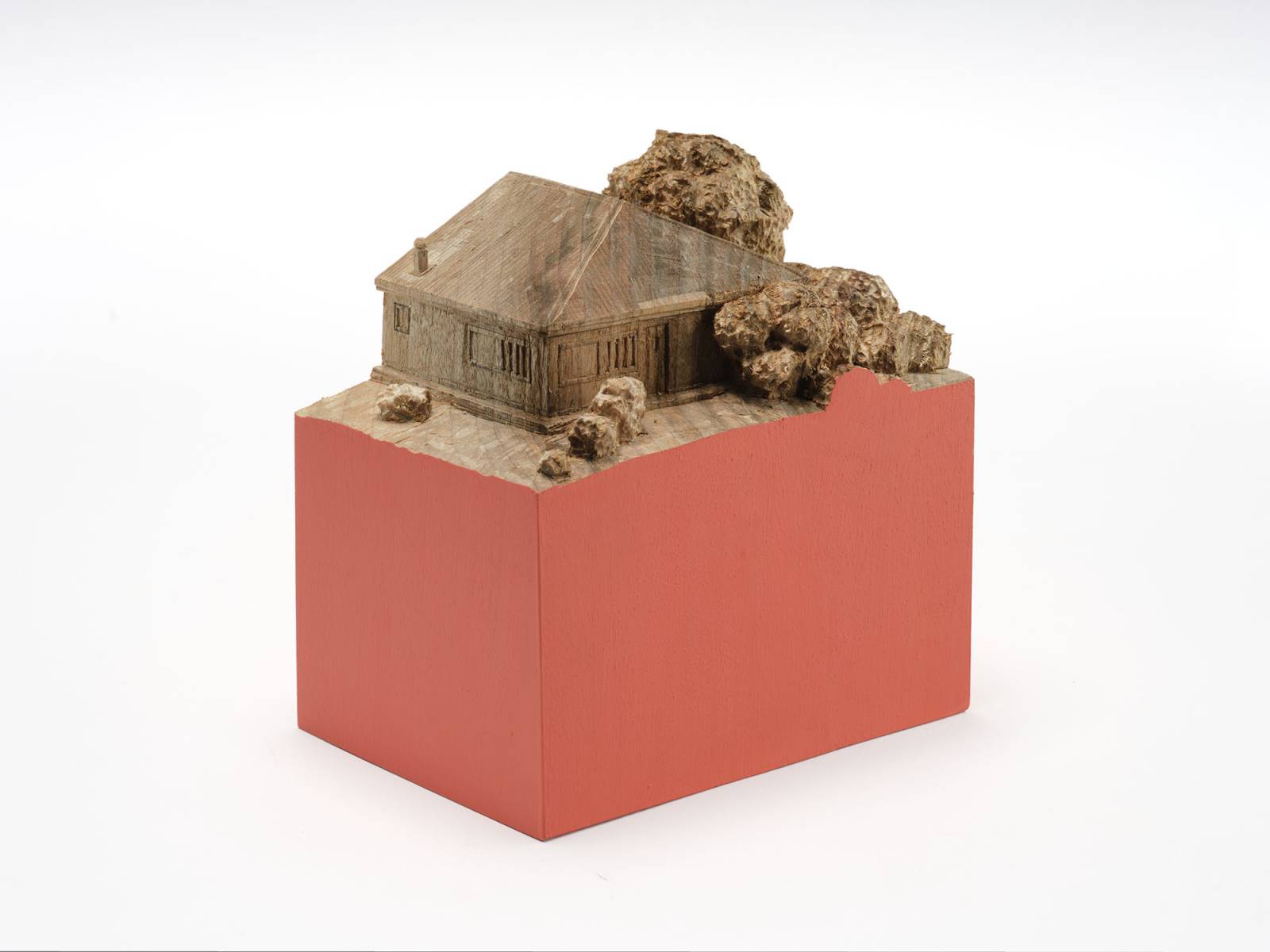
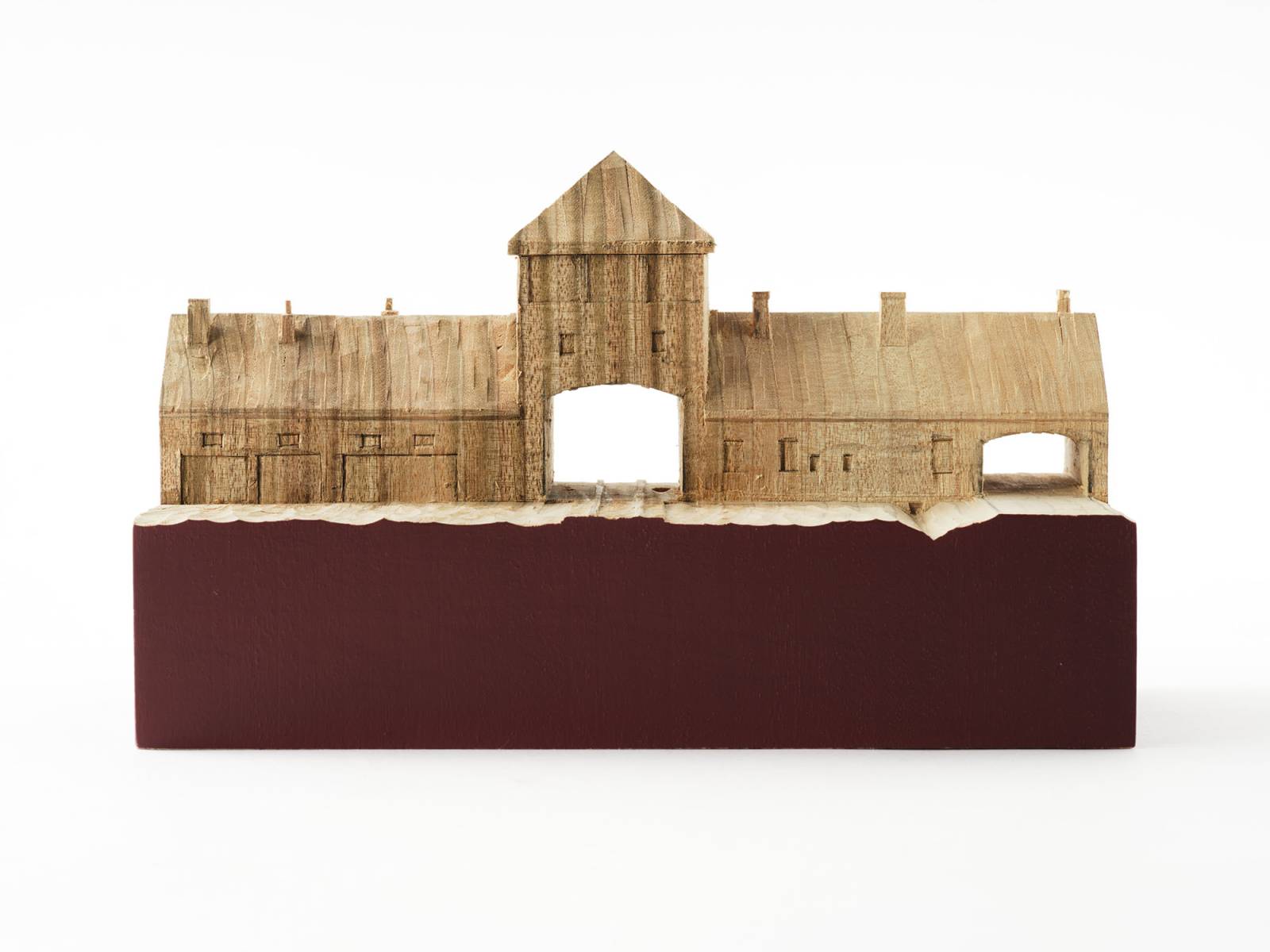
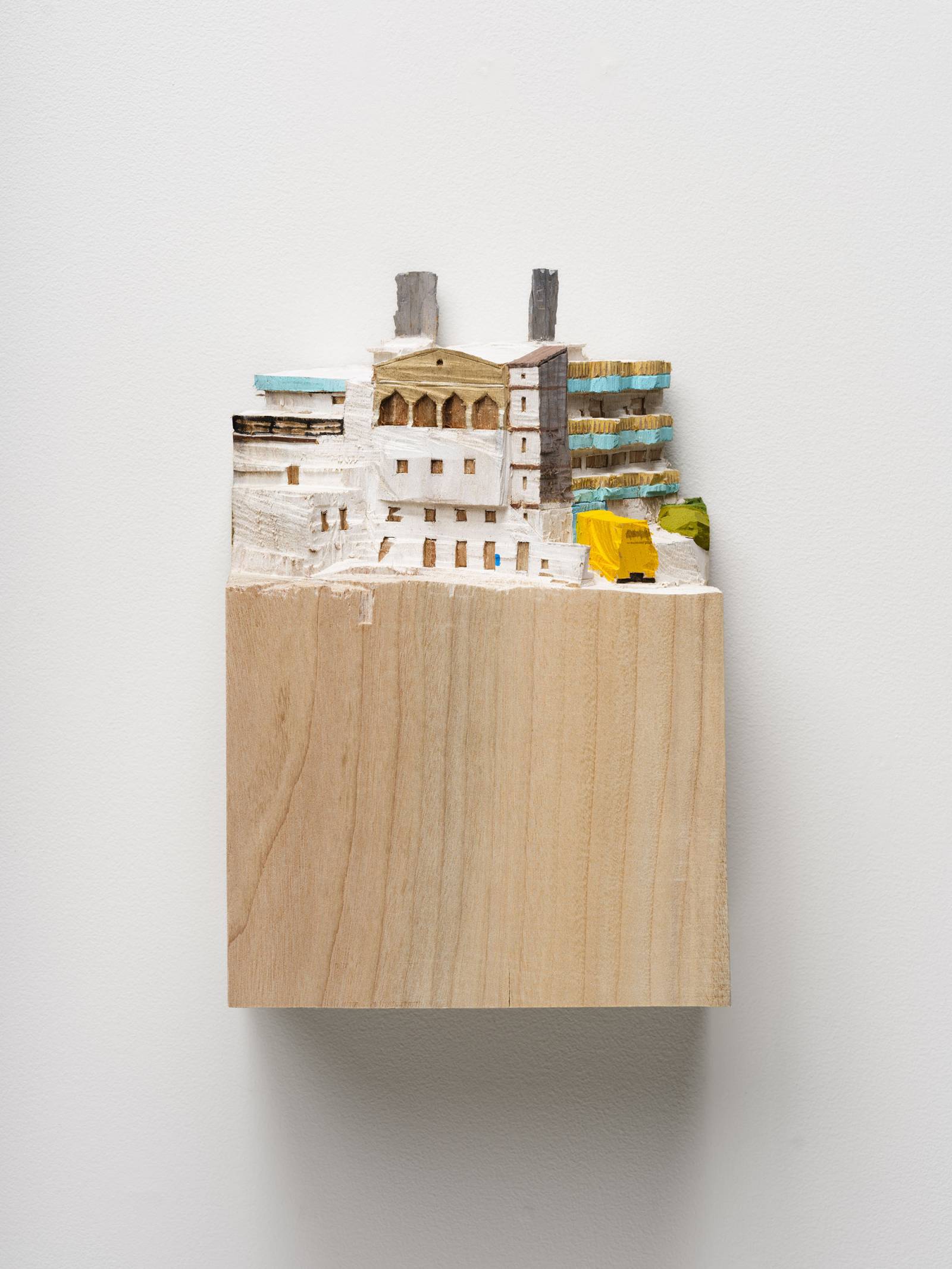
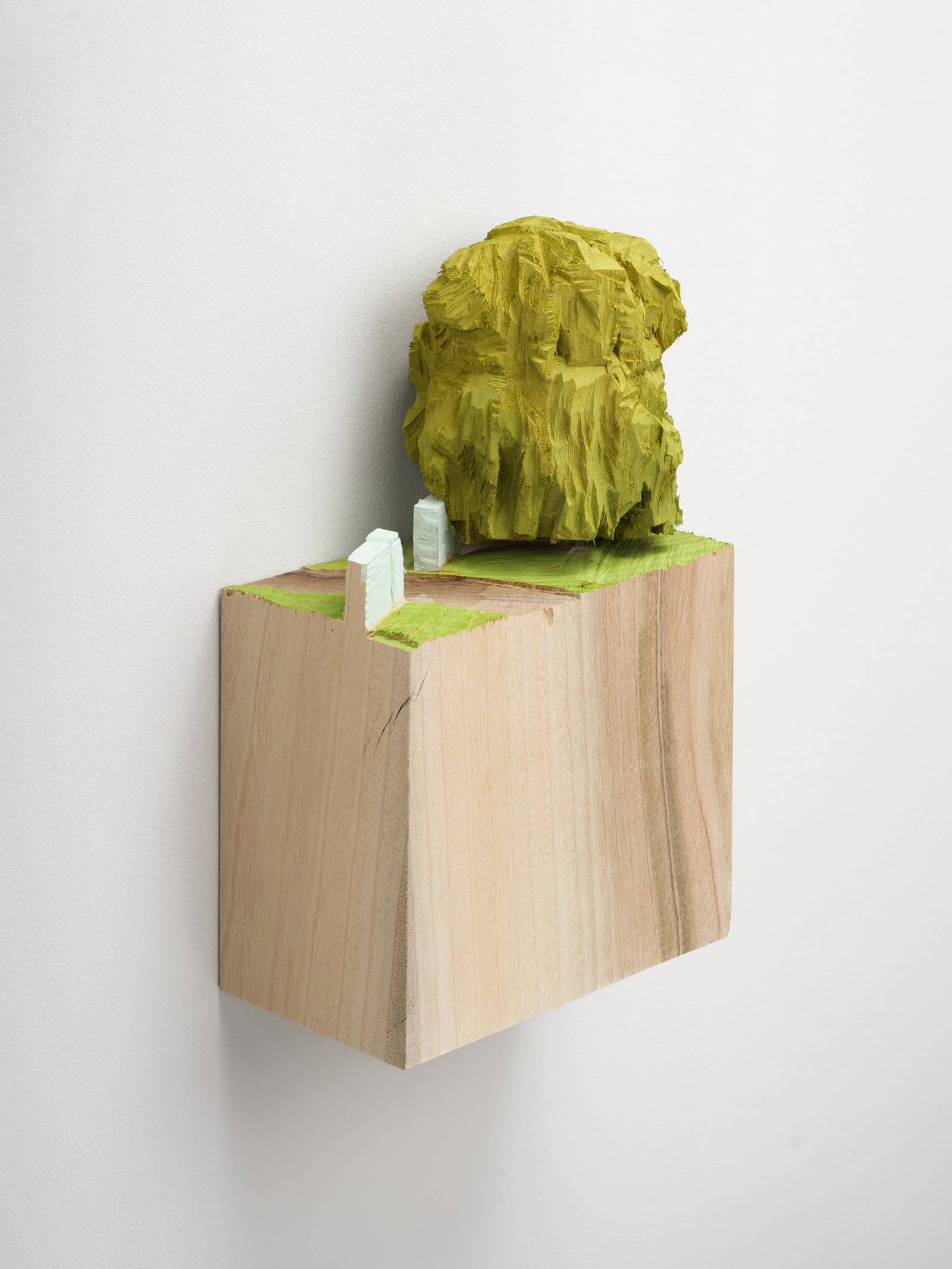
The first half of the exhibition that follows presents a series of works titled objects. Since early in his career, Suzuki has created sculptures of landscapes, particularly buildings, that he encountered in the American movies he watched as a child. Carved from similarly sized blocks of camphorwood are Western-style houses and buildings, gas stations, a tower of some kind, and a car, installed directly on the walls of the U-shaped gallery at close intervals. For a series that has typically been shown grouped together on a pedestal positioned near eye level, this method of presentation represents a new experiment, and the number of works is greater than before, too.
Was the intention behind lining the works along the walls to generate a sequence among them? If so, no elements of narrative continuity readily emerge. What I do see shared among them is a sharply modulated use of color; even where details have been omitted, the minimal palette is used to striking effect. The scenes, hazy in their particulars but nonetheless vividly real, recall impressions, or visual images, etched into memory.
The rough finish of some pieces, which leaves chisel marks apparent, may reinforce this point. Here, the sculpted form does not coincide with a clearly defined contour of the subject but rather expresses a disjointed, indefinite image wavering within. Suzuki’s sculptural concern, then, seems directed not at the formal qualities of the architectural subjects themselves, but rather at giving shape to the fragmentary images through which they appear in our minds.
Following the line of the wall, the viewer confronts each of these elusive forms in turn. The images suggested by their forms stir the visual sense but offer no definite landing point, leaving the viewer’s perception suspended. At the same time, the viewer clearly apprehends the sculptural character of the forms, their materiality and spatiality, an understanding that grows with each work encountered. As a result, the works gain palpable presence and reality, appearing not as individuals but as a whole. By integrating the viewer and the dimension of time, Suzuki organizes sculptures that are fragmentary when isolated into a unified entity and, in doing so, seems to direct the object series toward a mode of art that is completed only in experiential encounter.In contrast to the object series, where sculpturality was activated through the sequential unfolding of images following the succession of objects, the latter half of the exhibition, comprising a series titled reflections, is grounded by the form of the window frame—you could call it the support—and here, the formal exploration of the relationship to image is contained within the unit of each individual work.
Suzuki’s interest in the form of the window was already evident in his 2016 solo exhibition wall, roof, window. Moreover, the format of presenting an image through a framing device can be traced to “Ghost,” a lightbox work first shown at the 2017 VOCA exhibition, in which Suzuki photographed the façade and external walls of a building molded from clay and illuminated the image with the lightbox’s internal light. It was a work that pursued the whereabouts of sculptural presence within the flat image governed by light and shadow.
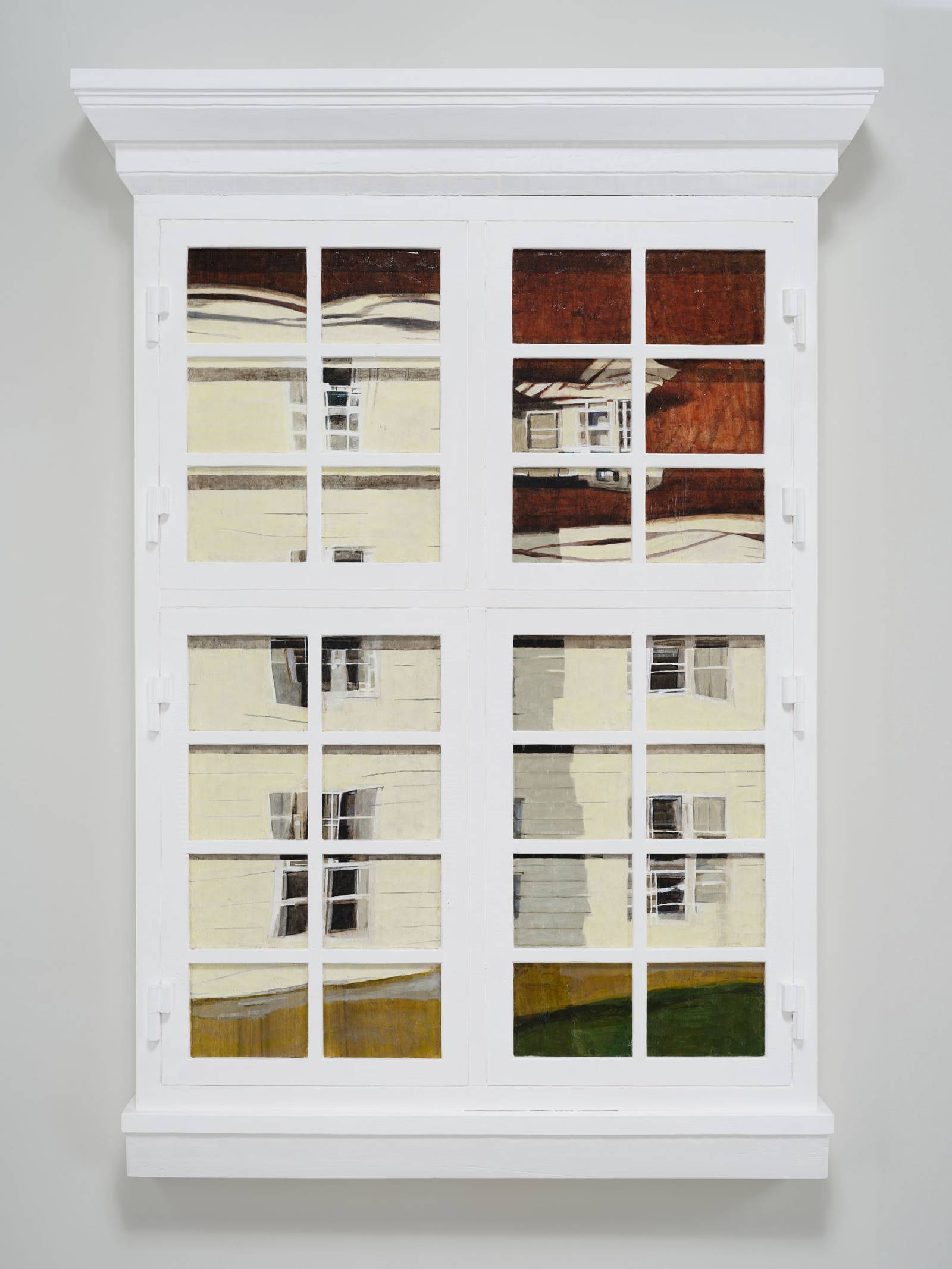
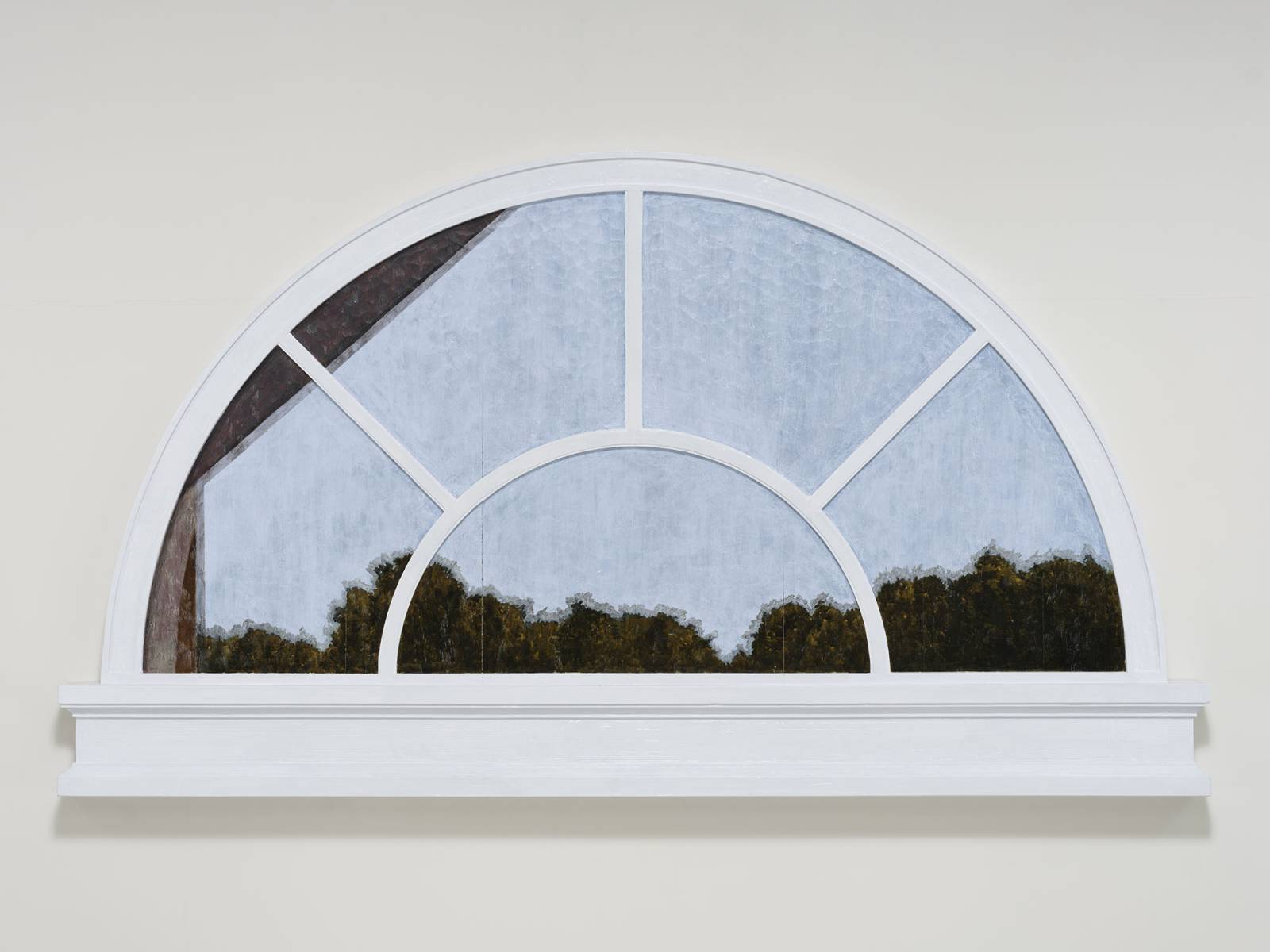
Looking at reflections now with this in mind, the window frames appear to offer a view onto the outside world, yet their physical construction clearly designates them as part of a building’s exterior. Therefore, the images depicted within the frames must be reflected scenes. Working from this premise, Suzuki paints complexly layered landscapes—eaves and dense foliage, the blue sky glimpsed between—with brushstrokes of a lively clarity. Distortions and unexpected reflections appear here and there, signaling their reflected nature, yet as if unconcerned with that condition, he pursues the countless possibilities of images seen through the window frame, resulting in a coherence that simultaneously produces a multiplicity of variations. Particularly notable is a work with a gray frame. Across five panels large and small, fragmented images of entangled branches and treetops are depicted from multiple perspectives, unbound by the constraints of reflection. In other words, borrowing the format of the window only to overturn its logic, Suzuki seems to declare the freedom of the image.
Of course, every work retains its window frame—as though to say a view can only be attained by accepting some kind of frame. Additionally, even the painted areas have been carved, and the joints connecting the boards remain exposed. The supports and images do not fully coincide; even as illusion is richly evoked, the image is ultimately returned to the logic of sculpture. As a result, the window panes acquire a distinctive materiality—one might call them images given flesh—while surfaces that should be smooth are instead uneven, revealing that what had initially possessed the orderly appearance of a readymade is in fact a carved sculpture.
Yet perhaps what is more important is the fact that landscapes presented as flat images have been deliberately carved. As indicated already by the aforementioned wall, roof, window, Suzuki’s sculptural concern with surfaces has long been explored through works that address the boundaries between a building’s interior and exterior. Now with the series reflections, scenery itself is carved, as though it were the very surface of the world. More precisely, it seems to me an attempt to sculpt something like a membrane that covers the world and can produce distortions and oscillations. In opposition to the contemporary tendency to compress images ever further, here we can identify an approach that reclaims and restores images to a world of depth.In Suzuki’s practice, where a consistently conceptual approach has always stood out, the series reflections—in which flat image, sculpturality, and the structure of the window frame are closely intertwined—marks a steady advancement of this direction. Meanwhile, it is surely significant that, in recent years, his works that most closely approach painting have revealed an attitude of overt resistance to the flatness of the image. Will his next works introduce a new mechanism to follow the window frame in probing the act of seeing and the nature of images, or will they explore the plasticity of the world without relying on such devices? My attention is fixed on his next move.
Translation by Eriko Ikeda Kay
< Back to Text Index